
2022

My Word for 2022: Forgive

After writing my last post, it got me thinking a lot about forgiveness. It’s been a topic that has been surfacing again and again in the last few months, and I’m thinking that I need to take note of it. 

I have a hard time with forgiveness. I’m sure everyone does to some extent, but I realized recently that my personality is wired to make it extra challenging. I’m an Enneagram 1 – and Ones are described as having a “strong, innate desire for fairness, accuracy, and order. They tend be bold advocates for the rights of others and when healthy, may challenge the status quo to make push for reforms and equality.” 

The book The Road Back To You calls Enneagram 1s “Reformers.” But another word that is also accurate is “Perfectionist.” Ones don’t like mistakes. They want things to be fair. Getting taken advantage of, or seeing another person get taken advantage of, is extremely aggravating for Ones. Ones often have issues with resentment and unexpressed anger.

All of that mixed together in one personality can make it very hard to forgive. I think a lot of Enneagram 1s also find it hard to offer forgiveness to themselves, due to their constant inner critic. 

Fairness and justice are wonderful things. Being an advocate for those who can’t advocate for themselves is awesome – and hooray to Ones for upholding those values. 

But it sure makes the world a hard place to live in sometimes. Life is not fair, it’s not always just. People are selfish and make mistakes. 

My personal focus for last year was “spiritual bravery.” I wanted to have more faith and courage in God. I wanted to release my desire to control everything all of the time. It was a good focus, and I’ve grown in faith and spiritual courage this past year. 

As I thought ahead to 2022, even though I was not super excited about it, all signs pointed to one word: Forgiveness. 

What were the signs, you may wonder? I had recently attended a Bible class at my church, and the teacher made the following statement:

“If you read everything that Jesus said in the Bible, and there’s not something that bothers you, you’re not paying attention.”

Randy Harris
Bible

He was specifically referencing Jesus asking us to forgive others, even those who don’t deserve it. (Matthew 18:21-22)

Then less than a week later, I found myself in a situation where I was really angry with a friend and needed to forgive her. I thought of a lot of reasons not to, and tried to rationalize with myself that she didn’t deserve for me to forgive her yet again. But then I remembered that Bible class, and I remembered what God calls me to do: forgive others. 

If I’m honest, I don’t want this to be my focus. (And that’s part of the reason why I am confident this is supposed to be my word for this year!) It’s going to be a challenge, and something that I am confident I will fail at many times.

But I know I need to be more intentional about fostering forgiveness, and I need to practice it more often so that hopefully down the road, it won’t be as difficult as it feels today. Honestly, I think the only way I’m going to make any progress at it is going to be through the grace of God, and his transforming power.

If you’ve grown up going to church or reading the Bible to any extent, you’ve probably heard many verses and sermons about forgiveness. So at this time, I won’t go into all the reasons why, from a Biblical perspective, we should forgive. (But if you’re interested, I found a site that goes into depth on 10 reasons why the Bible tells us to forgive – or you can always grab a Bible and do your own studying.)

My top reasons for wanting this to be my focus for this year do revolve around God and personal spiritual growth. But even if you don’t consider yourself a religious or spiritual person, there are still some great reasons to forgive others.

Read More »
How I Simplified My Parenting

I am a big fan of minimalism. The fascination started out for me mainly in the area of physical possessions. I very much like the look of less stuff. There’s hardly a better feeling to me than decluttering a room and getting rid of unnecessary things. It’s freeing. It makes me feel calmer, less anxious. Marie Kondo is my hero.

But the idea of minimalism and simplicity is about more than physical objects. Every aspect of our lives can be simplified.

To me, simplifying means cutting out the unnecessary and making time for what really matters. So in the case of physical stuff, as Marie would say, only keep things that “bring you joy!” This means you have to actually take time to figure out what exactly brings you joy, and what things are possibly worth giving up. As Ron Weasley would say: you need to sort out your priorities.

I recently decided that my parenting needed an overhaul – a simplification, if you will. I knew there were important things that I wanted to do as a mom, but it seemed like there was never time to do them. It felt more like I was trying to get through each day, rather than enjoying the precious moments with my child that I would never get back.

I’m a full-time working mom, so on the weekdays it really doesn’t leave a lot of real quality time for me to have with my son, Calvin. He’s 4 years old (4 and a HALF, I’m sure he would want me to say.) In the mornings, it’s a race to get all of us ready and loaded up in the car to get to daycare and work on time. In the evenings, it feels like a race to get dinner fixed for everyone, do the dishes (if they get done at all), and maybe have a bit of time to be together before it’s time to start getting Calvin ready for bed.

BEFORE simplifying our parenting…

We let Calvin watch t.v. in the evenings after getting home from daycare. We had previously agreed upon a set amount of t.v. he was allowed to watch (3 episodes), after he cleaned up his room. Well, by the time he cleaned his room and watched all his episodes, lo and behold, it was pretty much time to start the bedtime routine. We had even (I’m embarrassed to say) been letting him eat dinner in front of the t.v. most nights because otherwise there was not enough time for him to get all three episodes in. I felt frustrated – I knew that it was important for us to be eating at the table together as a family, but there just didn’t seem to be enough time.

Plus, there always seemed to be unfinished tasks that needed to be done: the dishes, folding laundry – and letting Calvin watch t.v. was useful in that it allowed my husband and I time to finally get some of those things completed. (At least that’s what we told ourselves.)

Read More »

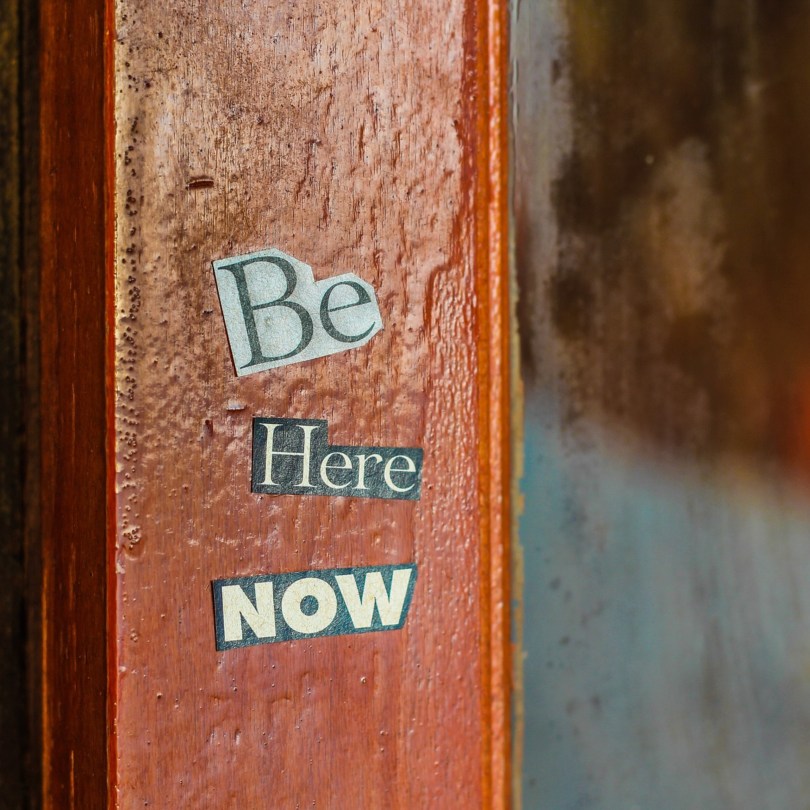
The Power of Now

I recently purchased the book The Power of Now by Eckhart Tolle because I was intrigued by this idea:

Depression is dwelling on the past, anxiety is dwelling on the future, and peace is dwelling on the present.

Maybe you’ve heard something like that before. There is a very similar quote attributed to Lao Tzu, although I’ve heard that it may be questionable who really said it.

But this idea that living in the present moment is the key to peace and happiness has been something I have been pondering for a while.

The premise of Tolle’s book is that depression is experienced because we are dwelling on negative feelings about the past, like regret, guilt, or self-loathing. Anxiety is experienced when we negatively dwell on the future, causing feelings of fear, worry, or dissatisfaction with life in general. True peace and happiness, according to Tolle, comes when we stop living so much in our heads, and take time to be present in the here and now.

There are examples in the Bible that would seem to echo this idea. The Lord’s prayer (Matthew 6:9-13) uses the phrase “give us today our daily bread” (NIV), which could imply that we only need to ask God for things concerning today (we don’t need to ask him for tomorrow’s bread, we just need today’s.) A little later in chapter 6, it says “therefore do not worry about tomorrow, for tomorrow will worry about itself.”

In the book of Exodus, when the Israelites are wandering in the desert, God provides daily food for them – manna and quail (ch. 16). The people are instructed to “go out each day and gather enough for that day.” Anyone who gathered more than a day’s worth found it to be rotting and “full of maggots” by the next morning.

Mindfulness, the practice of being fully present with where we are and what we’re doing, has been gaining popularity in Western culture over the past decade or so, and it also heavily utilizes the present moment, the NOW, to decrease stress and anxiety. Mindfulness meditations typically have you focus on sensations in your body and view your body and thoughts in a non-judgmental way. Headspace, one of my top picks, is a great app to check out for guided mindfulness meditations.

Obviously the idea of there being power in the now is not new or uniquely attributed to one person.

So what does it look like practically to live in the present moment?

Read More »