
My readers know that I’m a big fan of John Gottman and the Gottman Institute. Gottman is the author of the book Eight Dates, which is amazing and I think everyone in a serious relationship should read!
I love how Gottman is very matter of fact about marriage. For example he says, “you can’t be in a relationship and not have conflict. Not if you’re doing it right.” (Eight Dates, p. 6)
So it’s inevitable – we’re going to have conflict no matter how long we’ve been married, how much we love each other, or how good of a person we are.
When my husband and I started going to marriage counseling 6 years ago, I remember wondering how long we would need to go before our problems/conflicts would be solved, before our marriage would be “fixed.” What I’ve learned since then is that fixing our marriage and solving our problems are not synonymous. It doesn’t take the absence of conflict to be in a happy and healthy marriage – in fact Gottman would say it’s impossible.
Some problems are solvable. (Yay!) But most of our relationship problems, sixty-nine percent in fact, are perpetual problems. Perpetual problems, as you may have guessed, are those issues that are going to surface again and again and again in your marriage. (And that’s okay and totally normal!)
So if the absence of conflict is not the sign of a healthy marriage, then what is?
Gottman would say that the ability to continue to talk about your perpetual problems and learning to understand and accept the ways in which you are different from your spouse is key. (Eight Dates, p. 11)
One of the perpetual problems that we have been dealing with in our marriage for over 12 years is HOUSEWORK. The dreaded h-word.
I am the person in our relationship that always feels like more housework needs to be done, and that others are not pulling as much weight in this area. Clutter gives me anxiety. I feel like I can’t relax or have fun if the house is filthy. (Filthy being a very subjective term…)
Dean enjoys a clean house, but his tolerance for a mess is much greater than mine. So by the time he would naturally think about cleaning something, most likely I will have already cleaned it because it was bothering me so much to look at it.
Even taking our personalities into account, I am much more Type-A, a self-declared perfectionist who will notice the tiny details that are not right or are out of place. Dean is definitely more laid back and is not bothered by things to a similar degree (I envy him sometimes). We have learned that if we make a rule to just “clean things when you notice they are dirty,” I will end up doing a lot of cleaning and Dean will not. Not because Dean is a bad person, but because he’s not wired the same way I am.
Housework seems like a silly problem to be battling over for more than 12 years, but I think it’s super common because it’s so easy to get resentful at the other person if you feel like they are not doing their share. Essentially, any time you start keeping score in marriage and trying to determine if things are “fair,” it’s not going to end well. Marriage just isn’t always “fair.” I’m not saying you shouldn’t have conversations about housework, or that both partners should not be putting in effort towards a clean house, but it’s really easy to overestimate how much you do, and to not notice how much the other person has done. We always have a skewed view of reality to some extent, because we always initially see things from our perspective.
I found myself in one of my resentful moods recently, specifically in regards to housework, and Dean and I decided to have a discussion about it. Dean came up with the idea to assign each other chores after making a master chore list, and initially I was not interested. We have tried to do things like that before, and the farthest we usually get is just making the list, not actually doing the chores. I suggested hiring a housecleaner because we both work full time and it’s just hard to find time to actually do the cleaning.
Dean, being the more frugal one in our relationship, really did not want to pay someone else money to clean our house. So, we made a deal. We would try parsing out the chores again and holding each other accountable to doing them. We’d give it a trial period of a few months. If that didn’t work (if the chores were still not getting done) we could try a housecleaner.
I felt okay about this, and began almost immediately working on what would eventually be called “The Pye’s Ultimate ChoreList.” I started by listing all the tasks I could think of related to house cleaning and maintenance. Then I tried to think of how often each task should be done (daily, weekly, monthly, etc.) and who should be in charge of doing it.
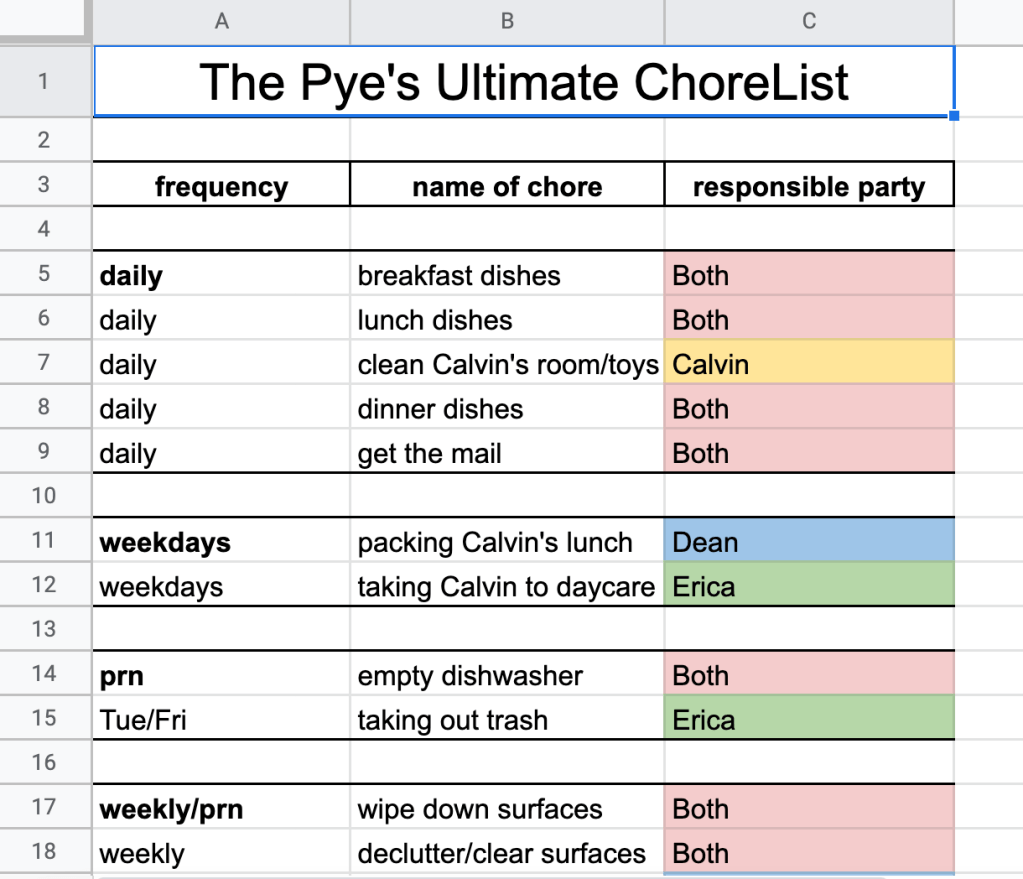
After some collaboration, we settled on what chores should be included, who should be doing them, and how often they needed to be done. This led to me making each of us personalized “chore charts” so we could easily see what tasks we had completed and which tasks still needed to be done. The charts are now hanging in our bedroom next to our closet, in a very obvious place.

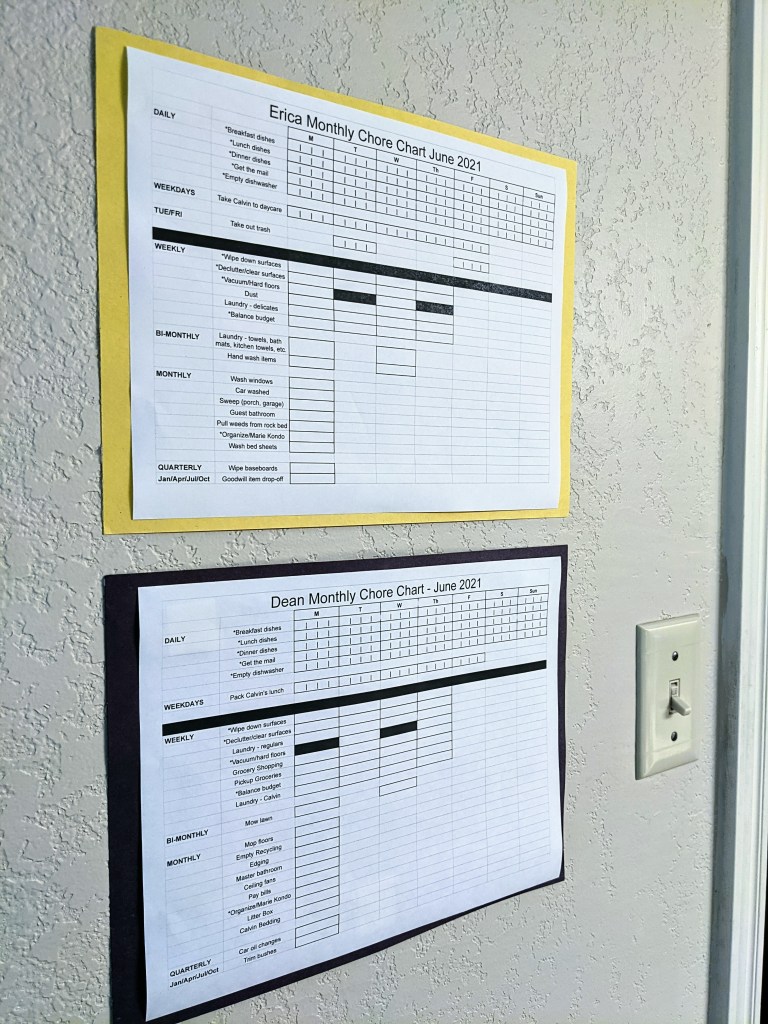
We are about to be finished with our second month of the trial period of the Ultimate Chore List, and I can honestly say that my anxiety and overfixation on housework has lessened. I definitely see Dean doing his share of chores, and even if I don’t see him doing them, I can look at his chart and easily know how much work he has done over the past month.
The Pye’s Ultimate ChoreList (trademark pending) is not a perfect solution to our perpetual problem, but it does actually seem to be working. Honestly, the secret ingredient to this being a successful “solution” to our perpetual problem is both of our efforts to show love to our spouse and be open to trying new things.
I guess we’ll find out if housework really is a perpetual problem, or if it is one that just took 12 years for us to solve! Either way, I’m looking forward to continuing to to work on our marriage (and having a clean house) together!
 Threads of Anxiety
I love this! And, I love that taking out the trash is yours. LOL
LikeLiked by 1 person
I am very curious to hear how this has turned out years later. Still working? Evolved or tweaked the lists? Same problem in my marriage, except I’m the more laid back one and my husband becomes easily resentful about chores not being done and is the frugal one.
LikeLiked by 1 person
That’s a fair question to wonder how it is still going! The short answer is… we gave up on the chore charts in a few months. I think it was too regimented – especially for my husband, because that’s just not how he thinks/works best. There are a few tasks that we have naturally “claimed” – I still take out the trash most of the time, but Dean has become our prime grocery-shopper and cook. And I know how much time/effort that takes, so I feel very grateful for that.
Another thing that may have helped change our dynamic is that I started only working 4 days a week instead of 5, and this gave me more time to get chores done so I could actually enjoy the weekends more. I know that is not a solution for everyone. I think that if both spouses are working, it is very difficult to have a clean house – and if there are kids too, there is just not enough time and energy for it! I think over time I started learning to have compassion on myself and give myself grace for things not being done.
That being said, for some people, clutter and mess really does add to their stress. So, if I was still working 5 days a week, I think I would have continued to push for a housekeeper. I think I would have hoped that my husband could see that it was important to me, and that maybe we could compromise and find the money to do that.
Lastly, I want to recommend a book (even though I haven’t read it, it’s on my “to read list”): “Fair Play” by Eve Rodsky. It has good reviews, and I’m super interested in seeing how it suggests tackling the problem of housework for married couples.
And last last thing, my husband and I still go to counseling – sometimes my resentfulness at undone chores does still build up, and it’s good to go and process those feelings with a professional. And sometimes, I’ve found there are deeper issues than housework at play – not feeling loved or valued, for example.
Okay, this became not a short answer very quickly (sorry!) Thank you so much for your comment!
LikeLike