When Your Kid is the “Only One” and You Feel Like a “Bad” Mom

This week has been hard – I was originally thinking “awful” which is also somewhat accurate, but obviously more negative. This week was our son’s first week back at daycare in two weeks because of the Christmas break – and our son has not handled it well. Most drop offs have ended with me walking away down the hallway, still hearing his screams as I exit the building. And it hasn’t just been screaming – he’s started running away from me and hitting when he doesn’t like something – he’s even begun to hit other people now if he’s extremely upset. 

My identity as a mom has been a bit shaken this week – I hate feeling like I can’t control my child (I hate not being in control of things in general…) I hate feeling like I’m the only one whose three-year-old has extreme tantrums anytime I try to leave him at daycare – those feelings of “what am I doing wrong?” begin to spring up, and I start convincing myself that everyone is judging me for being a “bad” parent.

I know my kid is a good kid, but I also know he is easily overwhelmed by people, loud noises, and changes to his routine. He used to tell me that he didn’t like daycare because “everyone said hello to him” – so I get it, he’s introverted, and that’s okay. Hitting, screaming, and throwing tantrums are not okay, however, as I have told my son numerous times this week in our heart-to-heart talks at the end of the day.   

I confided in a trusted friend this week about how I was struggling with mom guilt, how I was so tired of every day being a struggle for myself and my child – and she did exactly what I needed her to do, which was to speak words of truth to me, validate my feelings, and to remind me of the lies I was telling myself. Here’s part of a text she sent me yesterday:

“That is so hard, friend. It [my son’s behavior] feels like a reflection on you because you’re the mom – but really the reflection on you is that he’s a secure boy who knows he has a voice and feels comfortable and safe to express his frustration or anxiety…”

We talked about how his “bad” behavior was not being done maliciously, but the screaming and hitting were his way of trying to communicate that he felt unsafe, or scared, and that he really, REALLY was not happy. We talked about doing things to help validate my son’s feelings – saying things like, “I know this is hard for you and that you are not happy. You are safe. I will come back this afternoon to pick you up.” She reminded me that I was not alone, as I had convinced myself, and that many other parents were also struggling this week coming back from the holiday break. She reminded me that the people who might be labeling me a “bad” mom were not the people who mattered anyway.

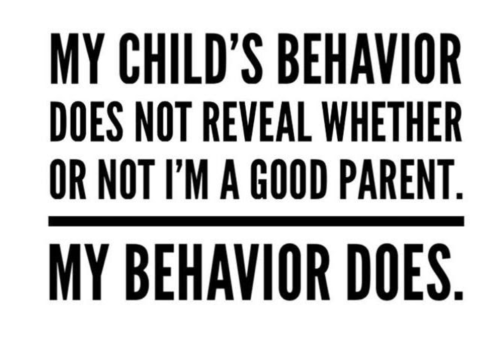
Something else I also had to come to terms with this week was my pride. I realized that I was allowing my pride to either be puffed up, or totally flattened, by my son’s behavior. I came across this posted on a friend’s Facebook wall, and I felt like it was meant for me to see:  Screen Shot 2020-01-11 at 11.08.25 AMI want to be proud of my son when he does good things and when he overcomes his fears. But I don’t want to let his choices totally define me and make me feel secure or insecure about my abilities as a mother. But how often do we find ourselves thinking this way? We see a “badly” behaved kid (or sometimes more accurately, probably an emotionally overwhelmed kid) and we sometimes unfairly assume that the parents are just failing to do their job or put in the effort. Many times, as I can attest to, the parents are doing the best they can – and they’re tired and frustrated and feel helpless. 
So, where do I go from here? My husband and I have tried to be creative in how we attempt to get through this phase – one thing we have tried to start doing is dropping our son off earlier than normal to daycare, when there are fewer kids in the classroom (aka. creating a less overwhelming environment). The few days we have done it, things have been better – not perfect, but better. We want to strike a balance between validating our son’s feelings, allowing him a voice to say “no,” but still requiring him to be able to function in day to day life. It’s hard, I don’t always find the right balance – but I’ll keep trying. 

As always, my hope is that sharing this post will help at least one other person to not feel so alone. The author Brené Brown says that shame grows in us when we convince ourselves we’re alone and keep our struggles a secret. Shame is destroyed when we experience empathy from others – that moment when someone says “me too.” If you need another parent to say “me too,” I’m here for you.

Thanks for reading.

The Strength of Empathy

To give some context for the title – my job requires all employees to take the StrengthsFinder quiz to determine your 5 top strengths (out of 34 total strengths). Empathy is in my top 5.   

Today was a weird day. I know it was 9/11, and so that made it a bit out of the norm from any other day, but that’s not what I’m talking about. I started the day at work, opening my email, calendars and checking Facebook. Obviously, there were a lot of 9/11 related posts. I started reading one post about a man, Tom Burnett, who was on the one airplane (United Airlines Flight 93) that did not reach its intended target, and instead was crashed into a field where it did not cause harm to anyone outside of the plane. I read the phone transcript between Tom Burnett and his wife – I read the part where he told her, “Don’t worry – we’re going to do something” – the last words he would ever say to his wife.

So this morning as work is just beginning, I’m already getting teary and emotional. I decided I could not read any more posts and got on to my emotionally-neutral work tasks. But all day I just couldn’t shake the feeling that I was having a hard time – the feeling weighed on me all day and I felt like I wanted to cry, but I hadn’t had an opportunity (I’m usually a private crier.)

I wondered what the deal was with me – why was I so emotional about something that happened 17 years ago? Why was I so upset about the deaths of people I never knew? All day I kept asking myself what was “wrong” with me – until I got home and talked to Dean about it. He told me there is nothing wrong with having empathy and compassion for people – there is nothing wrong with grieving for people you never knew, no matter how recent or old the tragedy is. Having compassion and empathy is a good thing!

There’s something else that has been weighing on me for the last week or so – the death of Botham Jean – another person that I never met or knew personally. I have been processing what happened to him and didn’t know how to express my thoughts and feelings on the situation. I feel a connection to him because he was a Harding graduate. I watched videos of him leading singing in chapel in the Benson auditorium, and if I had been just a few years younger, I probably would have crossed paths with him at Harding. I probably would have gotten to hear his beautiful singing voice live in chapel. It was hard to hear about a senseless death of a person in their own home. It was hard to think about how his mother must feel – having a son of my own, I hurt for her, although I know it’s nothing compared to the pain she must be going through. I felt pain and sadness, and at the same time felt joy and gratitude that my own son was alive and well.

My heart has also been hurting for people who have lost young children. Some of the people I know personally, and some are related to people I know, but my heart hurts for them the same. I don’t know what that is like – and I can only imagine the hurt and pain (not that I want to imagine it!) I feel helpless to do anything, because what can be done? A card seems so small for someone who has lost a child – but maybe it’s the small things that are the most important…

All that to say, that as I was leaving work at the end of the day, I knew I had hit an emotional-breaking point. I got in the car and immediately just started crying. Crying for the 9/11 deaths, for Botham Jean, for parents who have lost children before they got to meet them. I prayed to God for peace about all of it, but I also thanked him for the ability to have empathy and compassion for others – something that has not always been my strong-suit. I know God is hurting with those people too – he has compassion for all of us.

A week ago, Dean had the opportunity to come to one of my library staff meetings and give a presentation on trauma-informed care. You may have heard of this term, it’s kind of a buzzword these days – but if you haven’t, it’s basically a way of approaching and interacting with people that assumes that they have either gone through (or are currently going through) a traumatic experience. You create safe environments for people that don’t contribute to their pain, and you give a little extra grace to everyone you meet because you acknowledge that you don’t know everyone’s story. (This is my interpretation of trauma-informed care – Dean could give you a better definition.)

In light of so many tragic events going on in so many people’s lives, I don’t think there could be a better time to start thinking about how to implement trauma-informed care. How can I help make life a little easier for people dealing with extremely hard things? How can I show God’s love to those hurting? How can I fill people up instead of tearing them down? Today I was hurting for people that very obviously were dealing with trauma – death and loss of loved ones is certainly a traumatic experience. But I know there are also many people out there who are not so obviously hurting – people who say they’re doing “fine” when inside they are barely hanging on. How do I show extra love to people when I don’t know that they are hurting?

The lesson I’ve learned is: just assume that they are – and love everyone a little bit extra.


Body Image: My Story – The Good, the Bad, and, of course, the Ugly (pt. 1)

Can you remember when you first realized that what you looked like mattered? Or when you first became aware that people are quick to judge someone based on how they look? How old were you? When was the first time you ever felt self-conscious about your physical appearance?

I say “when” and not “if” because I think this is something everyone has gone through or struggles with at one time or another. Or perhaps all the time.

I would say it happened for me around 6th or 7th grade, you know, the junior high years. Weren’t those just the best?

FullSizeRender (14)
Here’s an awkward junior high picture of me when I was in 7th grade and visited Japan.

One of my first memories of starting to question if I was pretty enough happened while I was with my best friend from school at the time. We were in my room and I told her that I thought I could be considered attractive – and she burst out laughing, like, fall over on the floor laughing. This was my BEST friend mind you…

Another time at school, we had taken school pictures and our photos were getting passed back to us. I got mine in the envelope that has the clear plastic on it so you can see the photo underneath. And the girl sitting behind me yelled, “oh my gosh, RETAKE!,” while pointing at my picture. And you know what, I did get retakes. All because one person had made fun of how I looked.

I’m sure you all have stories from your childhood like this that you could share. It’s so sad for me to think about because I know how much it hurt at the time. And I was so young, maybe 10 or 11. My son is almost 2 years old, so how many more years does he have before he experiences something like this? How long can I protect him from the false idea that appearance matters? And not only that it matters, but that it’s what gives a person value?

Read More »