My Sister Rachel (Part 2): The Early Days

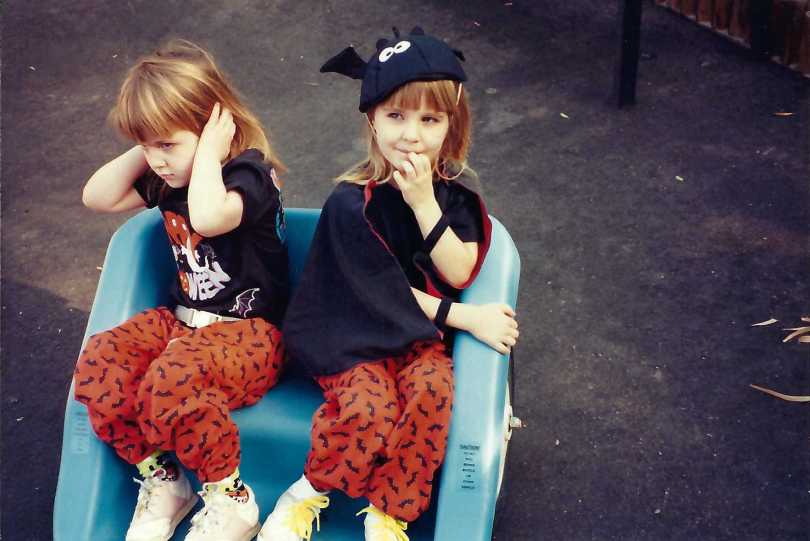
featured image: my sister and I in the "Buddy Buggy," I'm wearing my infamous bat costume and my sister is covering her ears probably due to sensory overload – this sums up our childhood well

Did you know that a set of female-female twins is called sororal twins? I literally learned that last month from a friend (who is not even a twin!)

I’ve been sorting through all of my memories of my sister, trying to decide which stories would be the best to share. There are too many to share exhaustively on the blog, so I’m trying hard to narrow it down. If there’s a story or a specific question you have that you’d like me to elaborate on, just ask!

All of these stories are taking place back when I was a child or young adult, so at a minimum, I’m writing about events that happened at least 16 years ago. That’s a lot of time for memories to morph and change, not to mention processing an event as a child is WAY different than experiencing an event as an adult.

Some of the stories I share will be funny, crazy, and exciting (some of them were funny only after the fact.) Some stories will be hard to read, sad, and might be triggers for painful experiences you’ve had in your own life. My goal in sharing all this is to offer my unique perspective, and to help my readers develop empathy and compassion for others.

So, here we go:

I guess it makes sense to start near the beginning, back in our younger days. I asked my mom to send me old pictures of my sister and I, and she wanted to be sure she sent me our “very first picture together”:

(Very funny, Mom!)

Probably the earliest back I have clear memories with Rachel would be when we were in preschool. We went to “Side By Side” preschool, which I doubt exists anymore. The whole premise of the school was to integrate children with disabilities and regular-functioning children – obviously my sister and I were a great asset because we added a “plus 1” to each of those categories. Somewhere inside a box at my parent’s house, there’s a newspaper article that was written about the preschool and my sister and I, simply because it was so novel to integrate “regular” kids and “special-needs” kids. (This was back in the 90’s, remember.)

Honestly, I don’t remember interacting very much directly with Rachel at preschool. This was not unusual – much of the time we were doing our own activities side by side (ha! see what I did there!) but not actually together. Rachel did not really play with other kids that I can recall. One of the listed signs of autism includes “inability to play ‘pretend’ games, preferring solo play” and I would say that described Rachel well.

Read More »
My Sister Rachel: A Series (Part 1)

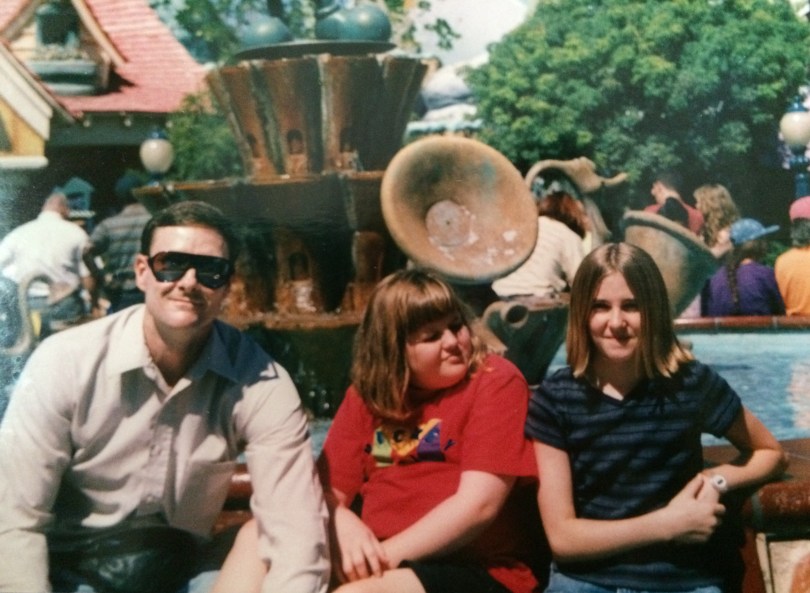
featured image: (from left to right) My dad, Rachel, and me at Disneyland – ToonTown to be exact. Circa 1996  

Last week it was my 34th birthday, but it wasn’t mine alone. I have a fraternal twin sister, Rachel. If you’re not up on your twin lingo, it means we are not identical, we came from two different eggs. (My 4-year-old son has recently learned that babies come from eggs, and every time I talk about something I did before he was born he will say “I was there!” because he was “one of my eggs.”)

It’s an interesting thing to be a twin – to never remember a time without the other person existing. I’m sure there’s a lot of psychological research out there about growing up as a twin and the impact it has on your relationship with each other… I’ll let someone else look that up if they want.

My relationship with my sister is very unique, not only because she’s my twin, but because Rachel is autistic. 

I think the word autistic can mean a lot of different things to different people. While there are certainly commonalities between people with autism, each autistic person is still unique with their own set of skills and personality traits, so obviously they do not all look or act the same. And of course you may be familiar with the term autism spectrum, which means that there is a range of different levels of traits that people with autism can have. 

Some of the signs or symptoms of autism may include things like:
* dislike of physical contact
* difficulty expressing needs
* resistance to changes in routine or surroundings
* intense reactions to sounds, smells, textures, lights, etc.
* difficulty understanding other people’s feelings
* delayed speech or language skills

Again, there’s a lot of information out there on autism, some of it’s outdated, so just try to make sure you’re researching current and accurate information. For example, in 2013 the DSM-5 essentially retired the term “Asperger’s syndrome” and now we would just say a person is on the spectrum or has mild autism. (“Mild autism” is not the proper diagnosis, but it could be helpful in trying to understand where a person falls on the spectrum.) This website seemed like it had good and easy to read information if you’re interested in learning more. 

I definitely don’t know all of the technical or medical terms about autism, but I always described my sister as being “low-functioning.” I guess maybe you could use the term “severe,” although that has a negative connotation in my opinion. So what does that mean? Well, it means that Rachel has very limited verbal skills. She needs someone to help her with daily tasks like getting dressed, brushing her teeth, cooking her food… We (my family and I) always knew that Rachel was never going to live independently on her own, she needs more support than that. 

Read More »

Rude or Kind, Words Matter

Earlier today I had a person speak very rudely to me at work – it was much more jarring than I expected it to be – by that I mean I was surprised by how much their words alone could hurt me. I walked away from that interaction extremely angry, wanting justice for the wrongs that I felt had been done to me.

I’m not the type of person who is particularly graceful at handling moments like these. I wish I could think faster on my feet and come up with the perfect response. But no, I’m that person who replays the event over and over in their head, crafting what would have been an ideal response in varying scenarios. I wish I didn’t get so flustered by my emotions. I tend to feel emotions hard and fast, and all I could think to say at the moment it was happening were things that I knew I shouldn’t. So instead, I didn’t say a lot, I just fumed inside.

As I reflected on the event, I remembered that Jesus went through countless encounters of people being rude to him, hating him, and obviously going so far as to eventually crucify him. How many times did Jesus desire “justice” for himself? How many times did emotions like anger overwhelm him? How many times could he have said, “Do you know who you’re talking to? God in the flesh!” Jesus could have used his power and status to put others in their place if he wanted to.

But he didn’t. He made himself lower. He prayed for his enemies. He forgave. He loved.

Read More »