
repeating white doors, one bright yellow door

Perpetual Problems in Marriage and How We Tried to “Solve” One of Them

My readers know that I’m a big fan of John Gottman and the Gottman Institute. Gottman is the author of the book Eight Dates, which is amazing and I think everyone in a serious relationship should read!

I love how Gottman is very matter of fact about marriage. For example he says, “you can’t be in a relationship and not have conflict. Not if you’re doing it right.” (Eight Dates, p. 6)

So it’s inevitable – we’re going to have conflict no matter how long we’ve been married, how much we love each other, or how good of a person we are.

When my husband and I started going to marriage counseling 6 years ago, I remember wondering how long we would need to go before our problems/conflicts would be solved, before our marriage would be “fixed.” What I’ve learned since then is that fixing our marriage and solving our problems are not synonymous. It doesn’t take the absence of conflict to be in a happy and healthy marriage – in fact Gottman would say it’s impossible.

Some problems are solvable. (Yay!) But most of our relationship problems, sixty-nine percent in fact, are perpetual problems. Perpetual problems, as you may have guessed, are those issues that are going to surface again and again and again in your marriage. (And that’s okay and totally normal!)

So if the absence of conflict is not the sign of a healthy marriage, then what is?

Gottman would say that the ability to continue to talk about your perpetual problems and learning to understand and accept the ways in which you are different from your spouse is key. (Eight Dates, p. 11)

One of the perpetual problems that we have been dealing with in our marriage for over 12 years is HOUSEWORK. The dreaded h-word.

I am the person in our relationship that always feels like more housework needs to be done, and that others are not pulling as much weight in this area. Clutter gives me anxiety. I feel like I can’t relax or have fun if the house is filthy. (Filthy being a very subjective term…)

Dean enjoys a clean house, but his tolerance for a mess is much greater than mine. So by the time he would naturally think about cleaning something, most likely I will have already cleaned it because it was bothering me so much to look at it.

Even taking our personalities into account, I am much more Type-A, a self-declared perfectionist who will notice the tiny details that are not right or are out of place. Dean is definitely more laid back and is not bothered by things to a similar degree (I envy him sometimes). We have learned that if we make a rule to just “clean things when you notice they are dirty,” I will end up doing a lot of cleaning and Dean will not. Not because Dean is a bad person, but because he’s not wired the same way I am.

Housework seems like a silly problem to be battling over for more than 12 years, but I think it’s super common because it’s so easy to get resentful at the other person if you feel like they are not doing their share. Essentially, any time you start keeping score in marriage and trying to determine if things are “fair,” it’s not going to end well. Marriage just isn’t always “fair.” I’m not saying you shouldn’t have conversations about housework, or that both partners should not be putting in effort towards a clean house, but it’s really easy to overestimate how much you do, and to not notice how much the other person has done. We always have a skewed view of reality to some extent, because we always initially see things from our perspective.

I found myself in one of my resentful moods recently, specifically in regards to housework, and Dean and I decided to have a discussion about it. Dean came up with the idea to assign each other chores after making a master chore list, and initially I was not interested. We have tried to do things like that before, and the farthest we usually get is just making the list, not actually doing the chores. I suggested hiring a housecleaner because we both work full time and it’s just hard to find time to actually do the cleaning.

Dean, being the more frugal one in our relationship, really did not want to pay someone else money to clean our house. So, we made a deal. We would try parsing out the chores again and holding each other accountable to doing them. We’d give it a trial period of a few months. If that didn’t work (if the chores were still not getting done) we could try a housecleaner.

Read More »
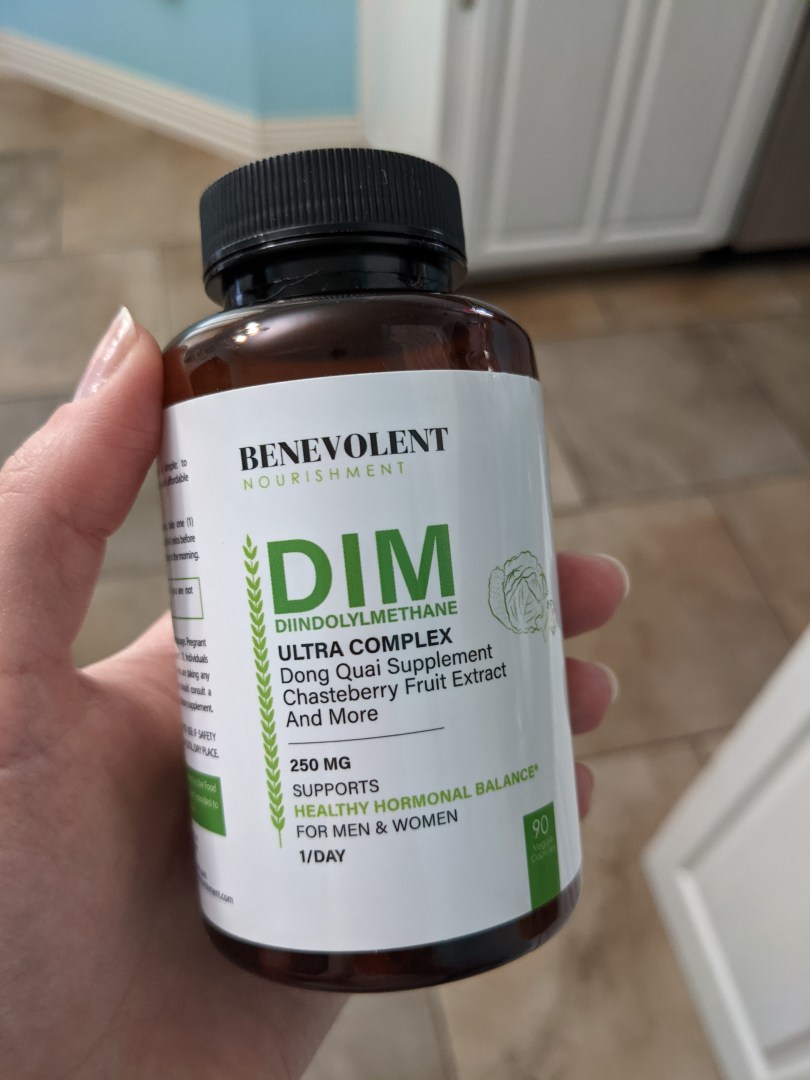

DIM (Diindolylmethane) Supplement bottle

DIM: the Supplement You Should Try for Hormonal Acne

I know what you’re thinking – you’ve seen clickbait like this before. There are tons of products out there being touted as the cure for acne, and if you’re like me, you’ve tried about a million different ones, all with less than stellar results.

For those who have followed me on my blog for a while, you know that I have a long history with acne. I was on Accutane as a teenager, and even after that I still continued to battle acne into my early 20’s and beyond. I went on extreme diets to try to control my acne and make my skin perfect. I got to where my acne was manageable, but never achieved perfection.

About 6 months ago, now a 34-year-old woman, I started getting crazy breakouts again for what seemed like no reason. Like, 3-4 new pimples DAILY! (Not just regular ones either, the huge ones that take like 2 weeks to go away which then leave marks on your skin that take months to go away!) That’s when I started getting strict with my diet again to try to control them, and I wrote a post titled, “Would You Eat Salmon Every Day for Clear Skin?”

That post got a lot of likes, and even now still seems to be popular among my readers. (I think it might be my most-liked post.) I think this is a testament (NOT to how great a writer I am – I wish!) to how many people are dealing with the issue of acne and looking for a solution. When you’re desperate for a cure, you are constantly Googling things, and you get to the point where you’re willing to try anything.

Part of the problem with acne is that it’s so hard to nail down the reason WHY you have it – acne can be caused by food intolerances, hormones, sensitivity to skin or hair products, dirty pillowcases, excess oil… I knew that some of my issues were coming from food – sugar seemed to cause breakouts in me, as well as too many carbs, or overeating in general.

But it also dawned on me that I was primarily dealing with hormonal acne, which doesn’t always respond to dietary changes or topical treatments. I came to this conclusion for three reasons:

1. I consistently had large breakouts on my chin

2. I remembered when I was pregnant, that my acne virtually went away

3. Back on one of my extreme dieting phases, when I got so thin my period actually stopped, my acne also stopped (aka. no hormones, no acne)

Back in April, I was in one of my Googling phases, trying to see if anyone out there had solutions I hadn’t yet tried or thought of for hormonal acne. I came across a health and wellness blog, Living Minnaly, and read a post from 2019 where she talked about how she had successfully managed her hormonal acne (and she even included pictures of her before and after, which is always helpful for us skeptics.)

You can read her post to hear her full story, but in a nutshell, one of the supplements she describes as “magical” for acne was Diindolylmethane (DIM). I had never heard of it before. She recommended this brand, which also contained dong quai and chasteberry (Vitex), two herbs that I had heard of in the context of treating hormonal acne.

Read More »
women fighter in sunset

Running with Knives (Part 2): the Self-Preservation Instinct

We each have a self-preservation instinct, to preserve our body, its life and effective function. This instinct, therefore, focuses us on physical safety, well-being, material security and comfort. Anxiety or stress may combine with this instinct to drive us to conserve or hoard energy and resources in response to demands from the environment or other people.

“Enneagram 27 Subtypes” | Integrative9.com

My therapist and I are both big fans of the Enneagram.

It’s pretty clear that I’m an Enneagram 1, but each Enneagram type also has a dominant subtype, or instinct. My therapist asked me which subtype I thought I was (the choices being self-preservation, one-on-one, or social), and I said I thought maybe I was a dominant social type. She smiled politely while shaking her head, and said to me, “self-preservation.”

We laughed together and I immediately knew she was right.

So much of my struggle with anxiety comes from the unknown, and being worried about being unprepared. I’m a worst-case scenario thinker, I expect the worst to happen so that if it does, I will be ready. Hence, why I always carry a knife in my pocket when I go out for a jog.

This is part two of a series on trauma, explaining how an event that happened 17 years ago still affects me today. (You can read part 1 here, where I share my story of almost getting abducted while walking my dog at night.)

In this post, I’d like to focus on the aftereffects of that traumatic event, how it changed me, and how I’m trying to strike a healthy balance between being overly fearful and feeling safe.

After watching my attempted kidnapper drive away that night, I went back inside and probably went into a bit of shock. I felt numb. My parents called the police and I remember a policeman asking me to describe the man. It felt so arbitrary, I knew they weren’t going to catch him based off of my generic description of his estimated height, weight, and hair color. I was so mad at myself for not memorizing the license plate number of his car.

The next day I went to school as normal and I don’t really remember thinking much more about it, except that my mom made sure I agreed I was never again going to walk our dog alone at night.

I do remember making a rule for myself that from that day on, I would never be out alone at dark – whether it was walking a dog, going to the store, checking the mailbox, or going for a run… and I followed that rule religiously from then on.

Of course there were times when I couldn’t quite avoid it entirely. Sometimes I’d be leaving from a friend’s apartment after dinner, or from working the night shift at the library, and I’d have to walk back out a ways to my car in the parking lot at night, by myself. I would always have my car keys in hand, ready to use them as a weapon. My old car had a key where you pushed a button and they key popped out of the side, like a mini switchblade – I figured it might be good enough to do some damage if I needed to poke an attacker in the eye.

I am usually always aware of my surroundings. Is there someone walking behind me? Is it a man? Which way would I run if he started chasing me? Does it look like I could outrun him?

I began to view most men as potential threats – if I was at home alone and the doorbell rang and it was a man, I wouldn’t always answer it. I’d let my dog bark and bark and bark until the guy left. If I did answer it, I was keenly aware of where the man was standing, and if I felt like I sensed any danger from him.

If I was getting into an elevator, and realized it was going to be me and a man alone inside, I would either wait for the next one, or have a very stressful 10-second ride to my floor as I hoped I did not get attacked.

It’s hard to say whether my prepare-for-the-worst, self-preservation personality was caused by my traumatic event, or if I naturally had those tendencies in me anyway. My guess is that it’s a bit of both, but that my traumatic experience intensified those tendencies, especially when it came to my physical safety.

It’s only been very recently that I’ve been working on finding the balance between recognizing the dangers out in the world, and being able to live in the world without fear. I do think it is important to be on guard against potential threats, but I don’t think it needs to be something that causes anxiety all the time.

Read More »